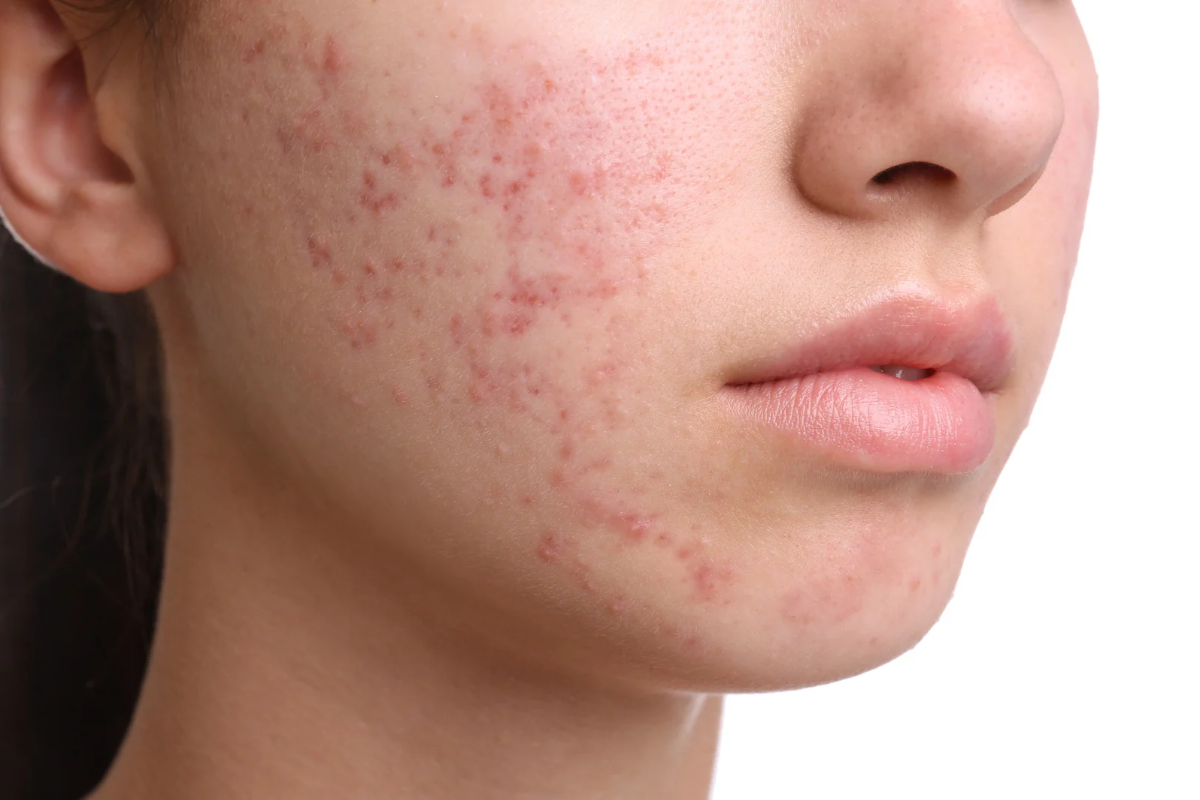
If you have acne scarring, you have probably noticed that it does not look the same everywhere. Some marks are small and deep, others are wider and shallow, and some change the overall texture of an area rather than standing out on their own. Those differences matter, because each type of scar responds to treatment in its own way.
It is also why there is no single laser that is right for everyone. A 2024 review of laser trials in acne scarring found no agreement on an ideal device and concluded that the choice depends on the type of scarring and the patient’s goals (Ziebart et al., 2024). Most people have more than one type of scar, and the best results usually come from a plan that addresses each one in a sensible order.
At Allure Aesthetics, we take a whole-face approach to acne scarring, considering your skin’s texture, tone and overall quality to create a personalized treatment plan focused on smoother, healthier-looking skin.
How Acne Scars Form
When a breakout is inflamed enough to reach the deeper layer of the skin, the skin repairs itself by making new collagen. Sometimes that repair falls a little short and the surface settles into a small depression, which is called an atrophic scar. Less often, the skin overcorrects and forms a raised scar. On the face, atrophic scars are far more common (Connolly et al., 2017).
If you are still breaking out, that is where we would start. Treating scars while new ones are forming makes progress harder to see, and in one laser trial, patients whose acne flared during treatment saw less improvement in their scars (Lu and Cai, 2022). Getting active acne under control first gives the rest of your plan a much better starting point.
Icepick, Boxcar and Rolling Scars
Dermatologists generally group atrophic acne scars into three types based on their width, depth and shape, and the system was designed so that scar type would guide treatment (Jacob, Dover and Kaminer, 2001). Understanding which types you have is one of the first things we look at together during a consultation.
Icepick scars are narrow and deep. They have a small opening at the surface but extend well into the dermis, which makes them the hardest type for surface treatments to reach.
Boxcar scars are round or oval with sharper edges. They are wider than icepick scars and can be shallow or fairly deep.
Rolling scars are broad and shallow with soft, sloping edges, and they give the skin a gently uneven texture. They form when fibrous bands beneath the skin pull the surface down.
Red or brown marks left after a breakout are a different concern. Post-inflammatory erythema and hyperpigmentation affect the color of the skin rather than its texture, and they are usually addressed with medical-grade skincare and, depending on your skin tone, BroadBand Light (BBL), rather than resurfacing.
Laser Resurfacing for Acne Scars
Laser resurfacing is central to how we treat acne scarring, and Main Line Today readers voted Allure Best Laser Treatments in the 2026 Best of the Main Line poll. Fractional lasers treat the skin in tiny, evenly spaced columns, leaving the skin around each one intact so it can heal well. As it heals, the skin remodels collagen in and around those areas, which gradually softens the depth and edges of a scar.
The evidence is strongest for boxcar and rolling scars. In a study of 35 patients treated with a non-ablative fractional laser, these two types improved the most, while icepick scars responded less (Sardana et al., 2014). It was a small study, but the pattern matches the wider research.
Across trials published between 2018 and 2022, ablative lasers produced the greatest improvement, with more downtime than non-ablative options (Ziebart et al., 2024). How much recovery time you can plan for is part of choosing the right approach, alongside the type of scarring.
How Halo Tribrid Treats Acne Scarring
The Halo Tribrid combines three fractional wavelengths in one treatment, each working at a different depth.
2940 nm is ablative and refines surface texture.
1470 nm is non-ablative and reaches deeper into the dermis to support collagen remodeling.
1927 nm is non-ablative and addresses pigment and uneven tone.
For acne scarring, the benefit is being able to treat surface texture and deeper remodeling in the same session. Fractional resurfacing at these wavelengths has been studied in acne scarring on its own. In a split-face trial of 27 patients, fractional 1927 nm and 2940 nm lasers each improved atrophic scarring when used individually (Lu and Cai, 2022). Acne scarring usually needs more than one session, and the number depends on the depth and type of your scars. Your provider will talk through whether it is right for you at your consultation.
When a Scar Needs a Different Approach
Some scars will not change much with resurfacing alone. Rolling scars held down by fibrous bands often improve only once those bands are released, a procedure called subcision, and deep icepick scars can respond better to focused techniques such as punch excision. When a surgical approach would serve you better, we refer to a dermatologic surgeon we trust and build the rest of your plan around that step.
Building Your Plan
Research on acne scar treatment consistently supports combining treatments matched to scar type rather than relying on a single device (Zaleski-Larsen et al., 2016). For most patients, that means getting active acne under control, addressing any tethered or deep scars with the right technique, and then refining texture with a series of resurfacing treatments. Medical-grade skincare supports your skin throughout, and daily sun protection matters at every stage of healing. When scarring is one part of a broader goal for your skin, it can be built into a Full Face Refresher® plan, so texture, tone and overall skin quality are addressed together over time. Our providers do not earn commission, so every recommendation in your plan is based on what your skin needs.
Your skin tone is part of the plan as well. Resurfacing carries a higher risk of post-inflammatory hyperpigmentation in deeper skin tones, and we manage that through device choice, settings and preparing your skin beforehand (Kaushik and Alexis, 2017).
If you have recently finished isotretinoin, you may have been told to wait six months before any laser treatment. A 2017 consensus from the American Society for Dermatologic Surgery found insufficient evidence to support that blanket delay for fractional laser resurfacing, though fully ablative resurfacing of the whole face is still generally delayed (Waldman et al., 2017). We still decide timing individually, so it is worth bringing up at your consultation.
What Improvement Looks Like
Acne scars can improve meaningfully, though they are rarely removed entirely, and it helps to know that going in. High-quality studies in this area are still limited (Boen and Jacob, 2019), and progress tends to be gradual, building across a series of treatments as collagen continues to remodel for months after your last session. We take photographs at set intervals so you can see the change clearly over time.
Starting With a Consultation
Your first visit begins with a thorough assessment of your skin and your treatment goals. Your provider will look at your skin under angled light to identify which scar types are present and where, talk through your history with acne and anything you have tried before, and take baseline photographs. From there, we put together a plan that sets out which treatments make sense, in what order, how many sessions to expect and how much recovery to plan around, so you know what the coming months look like before you begin.
Many patients start in late fall and winter, when spending less time outdoors makes recovery easier to plan around, and a plan started now is well underway by spring. Sun protection still matters year-round, before and after treatment.
Ready to explore your options for acne scar treatment? At Allure Aesthetics in King of Prussia, PA, our experienced providers create personalized treatment plans based on your skin, goals and lifestyle. Book a consultation to see what smoother, more even-looking skin could look like for you.
Frequently Asked Questions
What is the best laser for acne scars? There is no single best laser. Fractional resurfacing has the strongest evidence for boxcar and rolling scars, while deep icepick scars and tethered rolling scars often need other techniques first. The right choice depends on your scar types, skin tone and recovery tolerance.
What are the different types of acne scars? Atrophic acne scars are classified as icepick, boxcar or rolling. Icepick scars are narrow and deep, boxcar scars are wider with sharp edges, and rolling scars are broad with sloping edges. Most people have a combination.
Can acne scars be removed completely? Acne scars can be improved meaningfully, but complete removal is uncommon. Improvement develops gradually across a series of treatments and continues for months afterward.
How many treatments will I need for acne scars? Most patients need several sessions, often combining more than one type of treatment. The number depends on the depth and type of scarring and is set at a consultation.
How long is recovery after laser treatment for acne scars? It depends on the treatment and how deeply it is performed. Ablative resurfacing generally involves more downtime than non-ablative treatment, and we will go through what to expect for your plan at your consultation.
Should I treat active acne before acne scars? Yes. Controlling active acne first prevents new scars from forming during treatment and gives the plan a stable starting point.
References
Boen, M. and Jacob, C. (2019) ‘A review and update of treatment options using the acne scar classification system’, Dermatologic Surgery, 45(3), pp. 411-422. doi:10.1097/DSS.0000000000001765.
Connolly, D., Vu, H.L., Mariwalla, K. and Saedi, N. (2017) ‘Acne scarring: pathogenesis, evaluation, and treatment options’, Journal of Clinical and Aesthetic Dermatology, 10(9), pp. 12-23. PMID: 29344322.
Jacob, C.I., Dover, J.S. and Kaminer, M.S. (2001) ‘Acne scarring: a classification system and review of treatment options’, Journal of the American Academy of Dermatology, 45(1), pp. 109-117. doi:10.1067/mjd.2001.113451.
Kaushik, S.B. and Alexis, A.F. (2017) ‘Nonablative fractional laser resurfacing in skin of color: evidence-based review’, Journal of Clinical and Aesthetic Dermatology, 10(6), pp. 51-67.
Lu, K. and Cai, S. (2022) ‘Efficacy and safety comparison between 1927 nm thulium laser and 2940 nm Er:YAG laser in the treatment of facial atrophic acne scarring: a prospective, simultaneous split-face clinical trial’, Lasers in Medical Science, 37(3), pp. 2025-2031. doi:10.1007/s10103-021-03465-0.
Sardana, K., Manjhi, M., Garg, V.K. and Sagar, V. (2014) ‘Which type of atrophic acne scar (ice-pick, boxcar, or rolling) responds to nonablative fractional laser therapy?’, Dermatologic Surgery, 40(3), pp. 288-300. doi:10.1111/dsu.12428.
Waldman, A. et al. (2017) ‘ASDS Guidelines Task Force: consensus recommendations regarding the safety of lasers, dermabrasion, chemical peels, energy devices, and skin surgery during and after isotretinoin use’, Dermatologic Surgery, 43(10), pp. 1249-1262. doi:10.1097/DSS.0000000000001166.
Zaleski-Larsen, L.A., Fabi, S.G., McGraw, T. and Taylor, M. (2016) ‘Acne scar treatment: a multimodality approach tailored to scar type’, Dermatologic Surgery, 42(Suppl 2), pp. S139-S149. doi:10.1097/DSS.0000000000000746.
Ziebart, R.L., Antezana, L.A., Crum, O.M., Lynch, M. and Wyles, S.P. (2024) ‘Laser and energy treatments for acne scarring: a review of clinical trials’, Journal of Drugs in Dermatology, 23(12), pp. 1058-1062. doi:10.36849/JDD.8195.