Laser Season Is Here: What Actually Happens to Your Skin?
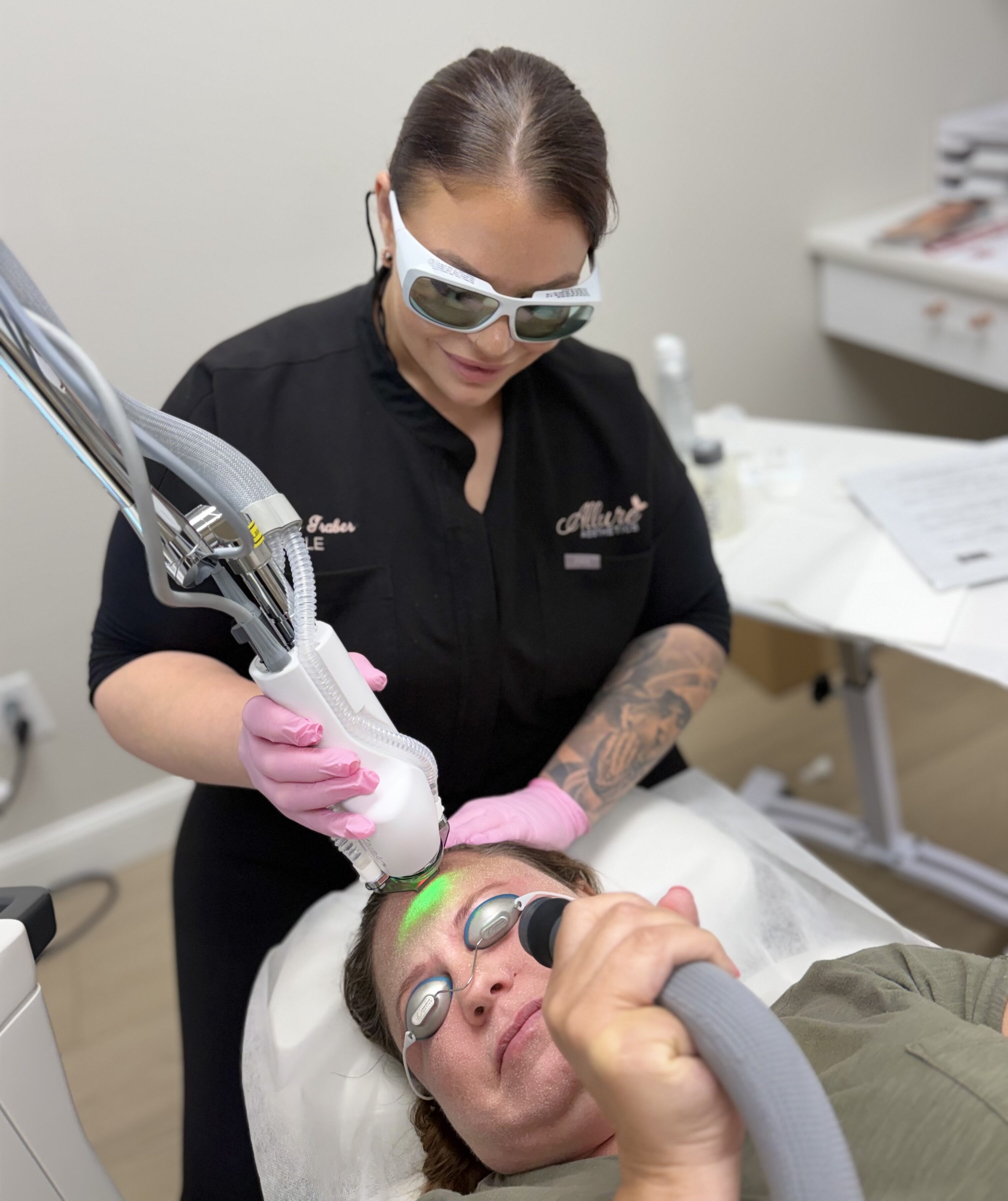
A laser treatment might take less than an hour. Your skin keeps working on the result for weeks afterward.
That is the part that makes laser treatments so interesting. The device starts the process, but your skin is what actually creates the change.
Laser energy is delivered in a controlled, precise way to target things like excess pigment, redness or damaged tissue. From there, the skin begins its own repair process. Old, damaged cells are cleared away, the surface renews itself and, depending on the treatment, new collagen begins forming underneath.
So while you may notice brighter or smoother skin fairly quickly, some of the most meaningful changes happen gradually.
This also explains why asking for the “best laser” is a little like asking for the best skincare product without saying what you want it to do.
Brown spots are not the same as redness. Redness is not the same as rough texture. Fine lines, pores, acne scarring and sun damage can overlap, but they do not all respond to the same technology.
The right treatment depends on what we are actually trying to change.
How Laser Skin Treatments Actually Work
Laser terminology gets complicated quickly, but the basic science is fairly simple.
Different things in the skin absorb different wavelengths of light.
Pigment responds to certain wavelengths. Hemoglobin in small blood vessels responds to others. Some resurfacing lasers target water within the skin, which allows them to work at specific depths and address concerns like texture, pores, fine lines and scarring.
The wavelength tells us what the treatment is going after.
Then there is the question of how the energy reaches the skin.
Some lasers are ablative, meaning they remove a controlled amount of the skin’s surface as part of the resurfacing process. Others are non-ablative, meaning the energy travels beneath the surface and heats the tissue without removing it.
One is not inherently better than the other. They simply create different levels of correction, recovery and collagen stimulation.
Many modern resurfacing lasers are also fractional. Instead of treating every bit of skin at once, they create thousands of microscopic treatment zones with healthy skin left in between.
That untreated skin is important. It helps the treated areas heal more efficiently, which is one of the reasons laser resurfacing no longer has to mean disappearing for weeks.
From there, the treatment can be adjusted even further.
How much of the skin is treated affects the overall level of correction. How deeply the energy travels affects what we are able to address beneath the surface.
It is why two people can have the same laser and have very different treatments.
The machine gives us the technology. The settings, treatment plan and understanding of the skin are what determine how that technology is used.
The Three Laser Skin Treatments We Use, and What Each One Is For
They are often presented as a ladder from gentle to strong. It is more accurate to think of them as three tools for three jobs.
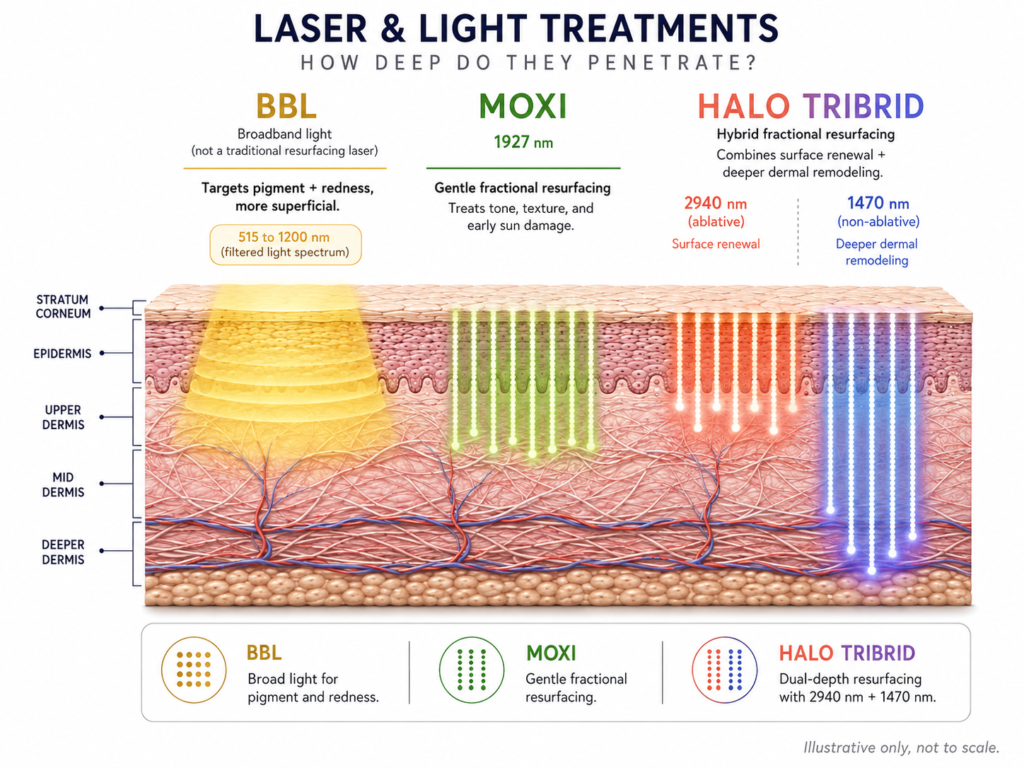
BBL, for brown spots, redness and vessels
BBL is broadband light, a filtered flash of many bwavelengths rather than a single beam, which makes it a slightly different animal from the lasers alongside it. It works by targeting pigment and hemoglobin, and that makes it the right instrument for the color side of sun exposure: brown spots, freckling, the background flush of rosacea, the fine vessels that turn up beside the nose.
When color is the problem, this is the most satisfying result in the practice. Two or three sessions and the complexion looks like it belongs to someone who has been indoors for a decade.
Downtime is brief, usually a day or two of warmth, with treated spots darkening before they flake away over the following week. Plan on a series of two to four, then a session or two a year to hold it, since sun exposure continues.
It works on color rather than texture, so it is best paired with something else when both are on the list. And because it targets pigment, it is at its safest in lighter skin tones. At Fitzpatrick IV and above we look at other options first.
Worth knowing: a small pilot study found that broadband light treatment shifted the gene expression pattern of aged skin toward a younger profile (Chang et al., 2013). It is an intriguing early finding in a small group of patients rather than proof that regular treatment prevents aging, and we would rather describe it accurately than lean on it.
Moxi, for early change and low downtime
Moxi is a non-ablative fractional laser at 1927 nm, a wavelength that water absorbs readily, which keeps the treatment in the upper layers of the skin. Microscopic columns, low density, surface left intact.
It is the right choice for early pigment change, for dullness, for skin in the late twenties and thirties that has no structural sun damage yet, and for maintaining a result achieved with something stronger. Two or three days of fine sandpaper texture and a faint bronze cast, then back to normal.
Moxi works cumulatively rather than dramatically, so it is planned as a series of three or four a month apart. That is a feature for anyone who cannot take a week of visible healing, and something to know in advance if you were hoping for a single decisive session.
One detail worth having: because 1927 nm stays shallow, the energy lands where melanin is most concentrated, so pigment management and conservative settings matter in deeper skin tones. The deeper fractional wavelengths, the 1550 nm class, reach water below the pigment-producing cells and carry a wider safety margin when texture is the main target. This is the kind of thing a good consultation should raise before you do.
Halo Tribrid, for Pigment, Texture and Deeper Renewal in One Treatment
Halo Tribrid is different because it brings three wavelengths into one treatment, allowing us to work on different layers of the skin at the same time.
The 2940 nm wavelength works at the surface, where rough texture and visible imperfections live. The 1927 nm wavelength targets superficial pigment and uneven tone. The 1470 nm wavelength reaches deeper into the skin to support dermal renewal and collagen remodeling.
Together, those three wavelengths give us much more flexibility within a single treatment. We can address sun damage, uneven pigment, texture, pores and deeper signs of skin aging without treating every concern in exactly the same way.
That customization is really what makes Halo Tribrid stand out. The three wavelengths are independently controlled, so the treatment can be adjusted based on what your skin actually needs. Someone primarily concerned with pigment may need a different balance than someone focused on texture, fine lines or acne scarring.
Halo Tribrid is also a more corrective treatment, so there is visible recovery. Expect several days of redness, swelling, bronzing and a rough or speckled texture as the skin begins to renew. Most of that visible healing happens within the first week, while collagen remodeling and continued improvement happen over the weeks and months that follow.
And stronger is not automatically better. The benefit of having three wavelengths is not that we can simply do more. It is that we can be more specific about where and how we treat.
When Another Treatment May Make More Sense
Not every skin concern needs a laser, and not every laser is the right fit for every skin.
Some types of persistent redness and visible vessels, for example, may respond better to a dedicated vascular laser. Deeper acne scarring or more significant sun damage may call for more aggressive resurfacing, such as fractional CO2, which also comes with a longer recovery period and requires careful patient selection.
For texture concerns, especially in skin tones where heat-based treatments need to be approached more cautiously, microneedling or other non-laser options may be a better place to start.
And sometimes the simpler treatment is the right one. A well-chosen chemical peel can do a great deal for superficial pigment, dullness and uneven tone without the need for laser resurfacing at all.
We do not offer every device or treatment available, and that is intentional. If something outside of our practice is better suited to your skin, we will tell you.
The goal is not to find a way to use a laser. It is to find the treatment that makes the most sense for the concern.
Who Laser Skin Treatments Suit, and When Waiting Is Better
The best candidates have more in common with each other than their ages suggest. Sun exposure has left uneven pigment, rough texture, visible pores, fine lines at rest, sometimes the traces of old acne. The underlying structure of the face is still well supported. The complaint is about the surface, and the surface is where the answer is.
Skin tone shapes the plan rather than closing the door, which is not how most published guidance treats it. The consideration is post-inflammatory hyperpigmentation, and it is managed through wavelength choice, lower energy and density, pigment preparation before and after, and a series of gentler sessions instead of one aggressive one. The evidence supports non-ablative fractional treatment in deeper skin tones on exactly that basis (Kaushik and Alexis, 2017). Microneedling, which works mechanically rather than thermally, is often a good starting point too. Experience with your specific skin type is the thing to ask about.
Some situations call for waiting. Active acne or any infection in the treatment area. A recent tan, since that is extra pigment sitting exactly where we are trying not to add heat. A history of keloid scarring, prior radiation to the face, pregnancy, immunosuppression, or a photosensitizing medication. A history of cold sores is not a barrier, just a reason for antiviral cover beforehand.
Isotretinoin is worth discussing rather than assuming. The twelve month wait repeated across most patient-facing content is more conservative than recent consensus work suggests, and the right interval depends on your history.
And if the next two weeks include an event you want to look wonderful for, that is a reason to book the treatment after it rather than before.
What Protects the Result
Daily sunscreen is the highest-value habit in aesthetic medicine, and the only one with randomized controlled evidence that it prevents visible skin aging rather than treating it. In the Nambour trial, adults assigned to daily broad-spectrum sunscreen showed no detectable increase in skin aging over four and a half years, while the as-needed group did (Hughes et al., 2013).
Read that with a laser treatment in mind. Sunscreen is what protects the collagen you spent three months growing.
A retinoid is the other reliable one, improving photoaged skin at the level of tissue rather than perception, with evidence going back to the 1980s (Weiss et al., 1988). Antioxidant serums and peptides sit a tier below, with mostly small manufacturer-funded studies and modest gains.
It is also worth knowing what skincare and lasers do not reach. Bone remodels, fat compartments shift, ligaments loosen. Those are structural changes, and they belong to a different part of the conversation. Normal facial change is not a flaw to be corrected, and plenty of the best outcomes we see involve treating skin quality and leaving everything else alone.
Order of Operations
Once a plan involves more than one treatment, sequence matters.
Color usually goes first. Clearing brown spots and background redness changes how everything else looks, and it reveals how much of the texture concern was really pigment. Patients regularly finish two BBL sessions and find the resurfacing they had scheduled is no longer the priority. Resurfacing follows, dosed to what your skin actually needs.
Season matters more than people expect. Healing skin is especially sensitive to ultraviolet light, which makes autumn and winter the natural window. So does event timing: four weeks of clearance is comfortable, two is not.
Budget belongs in the conversation, and raising it early makes the plan better rather than smaller. It shapes whether the sensible route is one stronger treatment now or a lighter series across a year, and both routes get you somewhere good.
Sometimes the best first step is neither. Skin that is inflamed or over-exfoliated heals unpredictably, and a few weeks of repair first produces a better result. Earlier is not automatically better, and waiting is a real recommendation.
Why We Look at the Whole Face First
Skin quality is one layer of how a face reads. Pigment sits on volume, volume sits on structure, movement pulls at all of it, and the eye takes in the relationships rather than the parts. Resurface a midface while ignoring temple hollowing and you have improved one thing and sharpened another. Treat the face and skip the neck and the difference shows at the jawline, which is why we treat both together.
What a Good Consultation Sounds Like
The aim is to leave with a plan you understand, not a purchase you agreed to. A few questions get you there.
What do you think my main concern actually is? The answer should be pigment, texture, or structure, and it should come before any device is named.
What depth and density would you use, and why? You are listening for the reasoning about correction against recovery time.
How many patients with my skin type do you treat? Especially useful at Fitzpatrick IV and above.
What would you not recommend for me, and why? A provider with a clear answer here is thinking about your face rather than the schedule.
How do you photograph results? Standardized lighting and angles are what let both of you judge month four honestly.
The Bottom Line
The machine starts the process. Your skin finishes it. What you are really choosing when you choose a laser treatment is the judgment in between: which target, what depth, how much, and in what order. Get that part right and the rest is your own biology doing what it already knows how to do.
Frequently Asked Questions
What do lasers actually do to your skin? They deliver energy that your skin absorbs as heat, in a controlled microscopic pattern. That prompts your own repair process to clear damaged tissue, rebuild the surface, and produce new collagen over the following two to four months. Ablative wavelengths remove tiny columns of the outer layer; non-ablative wavelengths heat deeper tissue without removing it. Nothing is added to the skin, which is why the result develops gradually.
BBL, Moxi, or Halo Tribrid: which one do I need? It depends on the target. Brown spots, redness and visible vessels respond to BBL. Early pigment change and dullness with minimal downtime suit Moxi. Texture, pores, fine lines and acne scarring alongside pigment call for Halo Tribrid. Many faces do best with two of them in sequence rather than the strongest single option.
How much downtime should I plan for? BBL is a day or two of warmth, with treated spots flaking over the following week. Moxi is two to three days of fine texture and a bronze cast. Halo Tribrid is five to seven days, most noticeable around day three, with makeup comfortable again by day five or six. Leave four weeks before an important event.
Are laser skin treatments safe for darker skin tones? Yes, with the right wavelength and settings. Non-ablative fractional treatment is well supported at reduced energy and density with pigment managed before and after (Kaushik and Alexis, 2017). Devices that target pigment directly, BBL included, need more caution and are generally not our first choice at Fitzpatrick V and VI. Ask any provider how often they treat your skin type.
Does laser resurfacing tighten skin? It firms the surface somewhat as new collagen develops, and it improves quality, tone and texture. It does not lift or reposition tissue. If laxity is the main concern, non-invasive tightening devices give modest results and surgery is the reliable option, which is worth knowing before you spend a year on the alternatives.
Not sure what your skin actually needs, or what should come first? Book a consultation and we will look at the whole face before recommending anything.
References
Chang, A.L.S., Bitter, P.H., Qu, K., Lin, M., Rapicavoli, N.A. and Chang, H.Y. (2013) ‘Rejuvenation of gene expression pattern of aged human skin by broadband light treatment: a pilot study’, Journal of Investigative Dermatology, 133(2), pp. 394-402. doi: 10.1038/jid.2012.287.
Hughes, M.C.B., Williams, G.M., Baker, P. and Green, A.C. (2013) ‘Sunscreen and prevention of skin aging: a randomized trial’, Annals of Internal Medicine, 158(11), pp. 781-790. doi: 10.7326/0003-4819-158-11-201306040-00002.
Kaushik, S.B. and Alexis, A.F. (2017) ‘Nonablative fractional laser resurfacing in skin of color: evidence-based review’, Journal of Clinical and Aesthetic Dermatology, 10(6), pp. 51-67.
Manstein, D., Herron, G.S., Sink, R.K., Tanner, H. and Anderson, R.R. (2004) ‘Fractional photothermolysis: a new concept for cutaneous remodeling using microscopic patterns of thermal injury’, Lasers in Surgery and Medicine, 34(5), pp. 426-438. doi: 10.1002/lsm.20048.
Weiss, J.S., Ellis, C.N., Headington, J.T., Tincoff, T., Hamilton, T.A. and Voorhees, J.J. (1988) ‘Topical tretinoin improves photoaged skin: a double-blind vehicle-controlled study’, JAMA, 259(4), pp. 527-532. doi: 10.1001/jama.1988.03720040019020.