



Why You Shouldn’t Pick Your Skincare Treatments À La Carte: The Case for a Customized Plan
You book a chemical peel because a coworker loved hers. You add a vitamin C serum because it went viral. You schedule a facial the week of an event, order a retinol online, and try a laser a friend mentioned. Every one of those decisions is reasonable on its own. The problem is that nobody is looking at the whole picture, and skin does not respond to a collection of good individual choices. It responds to a plan.
That’s the part most people skip. Ordering treatments à la carte, one thing off the menu, feels like progress. You’re investing money, you’re trying things, something should be working. But skin doesn’t add up your purchases and reward the total. It responds to sequence and timing: the right treatments, in the right order, at the right pace, chosen by a provider who looked at your skin before recommending anything. That’s a custom skincare treatment plan, and it’s the difference between years of spending with nothing to show and skin that actually changes.
So here’s what goes wrong when you treat skin in pieces, what the evidence says about following a coordinated skincare treatment plan instead, and how to know what your skin needs before you book another treatment.

The problem with ordering skincare off a menu
Your skin is one organ. When you treat it à la carte, you treat one organ in disconnected fragments, and the fragments often work against each other. A few specific things tend to go wrong.
Sequence gets ignored. The order of treatments matters as much as the treatments themselves. A peel or laser performed on a compromised skin barrier tends to produce more irritation, longer downtime, a higher risk of post-inflammatory hyperpigmentation, and an underwhelming result, because the skin is busy repairing damage instead of delivering the improvement you booked. The same peel on prepared skin behaves predictably and delivers more. Sequence is not a formality. It is most of the outcome.
Actives collide. People stack products that were never meant to be used together. Two exfoliating acids plus a retinoid plus a scrub is not four times the benefit. It is usually a stripped barrier, visible irritation, and skin that looks worse than where it started. Some ingredients cancel each other out. Some amplify each other into a problem. A shelf of individually good products is not a regimen.
You chase symptoms instead of causes. À la carte thinking treats what you noticed this month. Dullness this week, a breakout next week, a spot before a wedding. A plan asks a different question: what is actually happening in this skin, and what sequence of steps changes it. Those produce very different shopping lists.
Nobody owns the result. When each treatment is a separate transaction, no single person is accountable for whether the whole thing is working. You become the project manager of your own face, which is a lot to put on anyone who came in just wanting better skin.
The case for a custom skincare treatment plan: what the evidence says
The idea that a provider-built plan beats picking treatments off a menu is not marketing. It reflects how skin actually responds, and the foundation of it holds up in the research.
Start with what is best established. Two of the most reliable interventions in all of skincare are not glamorous, and they are not the exciting part of any menu. They are the base layer every good plan is built on.
The first is a topical retinoid. In a randomized, double-blind, vehicle-controlled trial, topical tretinoin produced statistically significant improvement in photoaged skin, while the placebo did not. Fourteen of fifteen faces treated with tretinoin improved, compared with none of the placebo group (Weiss et al., 1988). Longer-term work confirmed the gains are sustained with continued use rather than being a short-lived effect (Kang et al., 2005). A retinoid is not a serum you sample because it trended. It is a cornerstone, and it needs to be introduced correctly to be tolerated.
The second is daily sunscreen. In a randomized controlled trial that followed adults for four and a half years, the group using broad-spectrum sunscreen daily showed no detectable increase in skin aging over the study period, while the discretionary-use group did (Hughes et al., 2013). Sunscreen is the single most effective anti-aging step available, and it costs less than almost anything else on the menu. It is also the step people most often treat as optional. In a plan, it is not optional. It is the floor.
Notice what these have in common. Neither is a one-time treatment you book, enjoy, and forget. They are foundational, they work over time, and everything layered on top of them performs better because they are in place. That is the difference a plan makes. It puts the proven foundation first, then adds the right targeted treatment on top, matched to what your skin actually needs rather than what caught your eye on a menu. This is why we believe in guiding the choice of booster when you come in, rather than leaving it to a menu. The person best positioned to know which one will move your skin is the provider who assessed it.
The ZO Skin Health model: a regimen, not a shelf of products
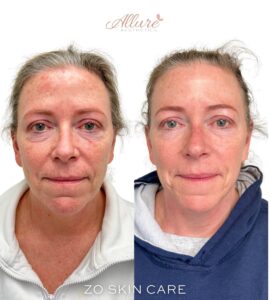
Allure builds many of our skincare plans around ZO Skin Health, the medical-grade line founded by dermatologist Dr. Zein Obagi. We use it because the philosophy behind it is the same one this whole article is about.
Dr. Obagi’s approach is called skin health restoration. Rather than treating individual complaints as they appear, it treats the skin as a living organ and works to get it functioning well at a cellular level, then keep it that way. A ZO regimen starts with a foundation (cleanse, exfoliate, and prepare the skin), then layers in correction and protection in a deliberate order, and it is designed to run alongside in-office treatments like peels and lasers rather than compete with them. Crucially, ZO is meant to be prescribed and tailored by a trained provider. These are potent formulations. Handed out without structure, high-strength retinols and acids can compromise the very barrier they are supposed to strengthen.
That is the honest version. Medical-grade skincare is not magic. The difference in formulation, concentration, and clinical backing is real, and it matters when you are trying to make measurable change in a defined window. But the product is not the plan. Even a great regimen used as a random stack can underperform a simple routine used correctly. The plan is what makes the products work, which is also why we do not sell products in isolation.
Face and neck age together
One of the clearest examples of à la carte thinking is treating the face and ignoring the neck. They age together, and treating one while neglecting the other creates a visible mismatch that people notice even when they cannot name it. The consensus literature on combined treatment specifically addresses the neck and décolletage as areas that should be planned alongside the face, not left out (Fabi et al., 2016). A plan treats skin as continuous, because it is. Healthy skin does not stop at the jawline. For treatments like microneedling and Moxi laser, we recommend treating the face and neck together for exactly this reason.
Timing: build the foundation, then layer
The recommended path is phased, and it usually looks like this.
First, the foundation. If the barrier needs work, that gets corrected and a daily regimen gets established. Depending on the skin, meaningful improvement here often takes a few weeks, and a more compromised barrier can take longer. This is not a delay tactic. It is the runway.
Second, correction. Once the skin is stable and tolerating its regimen, actives are introduced or advanced and targeted in-office treatments like chemical peels or laser begin on skin that is now prepared to respond.
Third, maintenance. Results are held and built on over time rather than chased in bursts before events.
The reason to do it in this order is compounding. Each step performs better because the one before it set it up. À la carte skips straight to step two on unprepared skin, which is why à la carte so often underdelivers.
What a plan-based approach to skincare looks like
Our thinking about skincare starts the same way every time: with an assessment, not a menu. This is the philosophy behind our Full Face Refresher® approach, a crown-to-neck assessment that looks at the whole picture before anything is recommended. When you arrive, your provider looks at what your skin is doing, what is compromising it, and what sequence of steps will change it, then guides you toward the treatment that fits, rather than leaving you to choose blind off a list.
A few recommendations follow from that, and they guide how we treat.
We recommend treating the face and neck together for microneedling and Moxi laser. Because they age together, addressing them as one is how you avoid the mismatch that isolated treatment creates, and it is what a coordinated result actually requires.
We recommend letting your provider give their expert advice on add-ons and boosters. The point of an assessment is to put that judgment to work. A provider who has looked at your skin is far better positioned to know which enhancement will move it than a menu is, which is why we suggest leaning on that expertise rather than guessing at it yourself.
We recommend the aftercare products your provider suggests, and it is worth being clear about why. Our providers do not earn commission, so those recommendations are not there to sell you more. They are there because the right post-treatment support protects your skin barrier while it heals, lowers the risk of prolonged redness or pigment issues, and helps the improvement you came for actually take hold. The recommendation exists for the clinical result, nothing else.
And if a Signature Facial, peel, Moxi, BBL, or microneedling belongs in your longer-term plan, mapping your home care into the timeline means that by the time you are in the treatment chair, your skin tolerates more, recovers faster, and responds better. That is how results accumulate instead of resetting.
What to look for in a provider
You do not have to choose us. You do deserve someone who works this way. Look for a provider who:
- Assesses your skin before recommending anything. If the first conversation is a price list, that is a menu, not a plan.
- Can explain the sequence and the why. A good provider tells you what comes first, what comes later, and the reason for the order.
- Gives real expert advice on treatments and boosters, rather than handing you a list and letting you self-select.
- Is not paid to upsell you. It is fair to ask how providers are compensated. Commission and clinical judgment do not mix well.
- Treats the face and neck as one canvas where the treatment calls for it.
- Revisits the plan over time. Skin changes. The plan should too.
The bottom line
À la carte skincare feels flexible, and the appeal is understandable. But skin is one organ, and it rewards sequence, foundation, and consistency, which is exactly what a coordinated plan provides and a menu cannot. The most reliable tools in the field, a well-introduced retinoid and daily sunscreen, only work as ongoing foundations, and the best in-office results come from treating skin that a plan already prepared. If you are going to invest in your skin, the highest return comes from a custom skincare treatment plan built by someone who looked at your skin first.
FAQ
Isn’t a full plan overkill if I only have one concern?
Even one concern has a cause, a right sequence, and a right pace. A plan for straightforward skin is simply shorter than one for complex skin. The point is not the number of steps. It is that someone chose them on purpose after looking at your skin, which is the part à la carte skips.
Do I need medical-grade products like ZO Skin Health to have a good plan?
They help when you want measurable change in a defined window, since the concentrations and formulations are stronger and better studied. The bigger point is that even the best medical-grade products work best as a structured regimen. Used as a random stack, potent products can stress the barrier instead of improving it.
How long before I see results from a skincare plan?
It depends on where your skin starts. Barrier support and early improvement often show within a few weeks, while pigment, texture, and fine lines respond over a few months of consistent use. A phased plan is built so each stage sets up the next, which is why the results tend to hold rather than fade.
Why does my provider recommend specific aftercare products?
Because recovery is part of how a treatment works, not an extra. Our providers do not earn commission, so the recommendation is not about selling you more. The right aftercare protects your barrier while it heals and helps the result take hold, which is the whole reason it is suggested.
What is the first step to getting a custom skincare treatment plan?
An in-person assessment. A provider looks at your skin, talks through your goals and history, and maps out a sequence for the face and neck. If you would like guidance built around your skin rather than a one-size-fits-all menu, our team at Allure Aesthetics in King of Prussia, PA would love to help. You can book an appointment or call or text us at (610) 393-1253.
References
Fabi, S.G., Burgess, C., Carruthers, A., Carruthers, J., Day, D., Goldie, K., Kerscher, M., Nikolis, A., Pavicic, T., Rho, N.K., Rzany, B., Sattler, S., Seo, K., Werschler, W.P. and Sattler, G. (2016) ‘Consensus recommendations for combined aesthetic interventions using botulinum toxin, fillers, and microfocused ultrasound in the neck, décolletage, hands, and other areas of the body’, Dermatologic Surgery, 42(10), pp. 1199-1208. doi:10.1097/DSS.0000000000000869.
Hughes, M.C.B., Williams, G.M., Baker, P. and Green, A.C. (2013) ‘Sunscreen and prevention of skin aging: a randomized trial’, Annals of Internal Medicine, 158(11), pp. 781-790. doi:10.7326/0003-4819-158-11-201306040-00002.
Kang, S., Bergfeld, W., Gottlieb, A.B., Hickman, J., Humeniuk, J., Kempers, S., Lebwohl, M., Lowe, N., McMichael, A., Milbauer, J., Phillips, T., Powers, J., Rodriguez, D., Savin, R., Shavin, J., Sherer, D., Silvis, N., Weinstein, R., Weiss, J. and Hammerberg, C. (2005) ‘Long-term efficacy and safety of tretinoin emollient cream 0.05% in the treatment of photodamaged facial skin: a two-year, randomized, placebo-controlled trial’, American Journal of Clinical Dermatology, 6(4), pp. 245-253. doi:10.2165/00128071-200506040-00005.
Weiss, J.S., Ellis, C.N., Headington, J.T., Tincoff, T., Hamilton, T.A. and Voorhees, J.J. (1988) ‘Topical tretinoin improves photoaged skin: a double-blind vehicle-controlled study’, JAMA, 259(4), pp. 527-532. doi:10.1001/jama.1988.03720040019020.