Skin Barrier Health: Why It Should Be Your First Priority
If you’ve spent real money on skincare treatments and felt like nothing was actually changing, the problem might not be the products. It might be the surface they’re sitting on.
Skin barrier health is the foundation behind almost everything we do in aesthetics, from a basic skincare regimen to a chemical peel to a Moxi or BBL session. When the barrier is healthy, treatments work better, recovery is smoother, and your skin looks calmer, clearer, and more even by default. When it isn’t, even the best ingredients and most advanced procedures tend to underperform (and can sometimes irritate the very skin you’re trying to improve).
This is why our skincare specialists at Allure often recommend starting with a customized regimen before scheduling more aggressive treatments like chemical peels or laser. It isn’t a delay tactic. It’s how we make sure the next step actually works.
Here’s what that means in plain terms, and how to know whether your skin barrier is healthy, compromised, or somewhere in between.
What is the skin barrier?
Your skin barrier (technically the stratum corneum, the outermost layer of your epidermis) is your first line of defense between you and the outside world. It keeps water in, keeps irritants out, and helps regulate everything from temperature to inflammation to immune response.
The simplest way to picture a healthy skin barrier is “brick and mortar”:
- The bricks are corneocytes, flattened skin cells that form the structural layer.
- The mortar is a precise lipid blend, roughly half ceramides, with cholesterol and free fatty acids making up most of the rest.
- Coating that whole system is the acid mantle, a slightly acidic film (pH 4.5 to 5.5) that supports your skin microbiome and keeps barrier proteins working correctly.
When all of that is intact, the barrier holds water in (low transepidermal water loss, or TEWL) and resists incoming irritants. When it’s disrupted, water escapes faster than your skin can replace it, and irritants, allergens, and microbes get easier access to deeper layers. That’s where redness, sensitivity, breakouts, and persistent dehydration usually come from.
Signs your skin barrier may be compromised
Most people don’t realize their barrier is impaired. They assume their skin is just “sensitive,” “combination,” or “not responding to anything.” A compromised skin barrier is often the actual cause.
Common signs include:
- Tightness, especially right after cleansing
- Stinging or burning when products go on, even gentle ones
- Persistent redness or flushing
- Visible flaking, dry patches, or rough texture
- Sudden reactivity to products you used to tolerate fine
- Breakouts that feel different from your usual pattern (often small, inflamed, or rashy)
- Skin that looks dull, tired, or “thin,” even when well moisturized
- Dehydration that doesn’t resolve with moisturizer alone
If several of these feel familiar, your barrier likely needs attention before anything else changes in your routine.
What damages the skin barrier
Most barrier damage isn’t dramatic. It builds up over weeks or months through habits and exposures that look harmless on their own.
Common contributors:
- Improper use of actives without a structured protocol or adequate skin conditioning—this is the most common cause we see at Allure.
- Harsh cleansers. High-pH, sulfate-heavy cleansers can strip the lipid layer and disrupt the acid mantle. Squeaky-clean is not the goal.
- Aggressive scrubs and tools. Daily exfoliating brushes, gritty physical scrubs, and over-zealous spin tools can mechanically thin the barrier.
- Sun exposure. Chronic UV damage is one of the biggest contributors to long-term barrier dysfunction and accelerated skin aging.
- Environmental stress. Cold weather, low humidity, indoor heat, hard water, and pollution all increase TEWL.
- Sleep, stress, and hormones. Elevated cortisol, poor sleep, and hormonal shifts can impact barrier function and inflammatory response.
- Procedures performed on a fragile baseline. Doing a deep peel, an aggressive laser, or even microneedling on a compromised barrier increases the risk of prolonged redness, post-inflammatory hyperpigmentation, and unpredictable healing.
The pattern: barrier damage usually comes from doing too much, not too little.
Why skin barrier health comes before chemical peels and laser treatments
This is where strategy matters, and where most rushed treatment plans go wrong.
Chemical peels and laser treatments (Moxi, BBL, and others) are some of the most effective tools we have for tone, texture, pigment, and overall skin quality. But they all work the same way: by creating a controlled injury to the skin, then asking the skin to repair itself in a more organized, even, healthier state. That repair process depends almost entirely on how well your skin barrier was functioning before the treatment.
Treating a compromised barrier with peels or lasers tends to produce:
- Stronger irritation than expected, even at conservative settings
- Longer downtime, with redness, peeling, or sensitivity that lingers past the typical recovery window
- Higher risk of post-inflammatory hyperpigmentation (PIH), especially in medium and deeper skin tones, because inflammation is harder to control on a fragile baseline
- Underwhelming results, because the skin is too busy repairing barrier damage to focus on the cosmetic improvement you booked the treatment for
Treating a healthy barrier with the same peel or laser tends to produce:
- Predictable recovery
- Better tolerance of higher (more effective) settings or peel depths
- Cleaner, more even cosmetic results
- Faster cumulative progress, because each session builds on a stable foundation
This is why our skincare specialists often recommend tackling home care before someone’s first chemical peel or laser session, especially if their barrier shows any of the signs above. It’s how we make sure the treatment actually delivers what it’s supposed to.
How to repair and maintain a healthy skin barrier
If your skin barrier is impaired, it’s best to correct what’s not working and support the skin in functioning properly again.
1. Simplify-but don’t eliminate structure.
Instead of stopping everything, we adjust what’s contributing to imbalance and focus on a more controlled, supportive routine.
Actives may be reduced or modified, but they’re typically reintroduced strategically to help the skin normalize—not avoided entirely.
2. Use a cleanser that supports skin function.
Cleansing should effectively remove oil, debris, and buildup without leaving the skin feeling stripped or overly tight.
Proper cleansing is essential for maintaining balance and allowing the skin to function optimally.
3. Focus on skin conditioning, not just “repair.”
Rather than relying on heavy moisturizers to compensate for dysfunction, the goal is to help the skin restore its own natural hydration and resilience.
This includes:
- Supporting epidermal turnover to improve overall skin quality
- Using ingredients that calm visible irritation while still allowing the skin to adapt
- Gradually building tolerance so the skin becomes stronger and more resilient over time
4. Wear daily SPF.
UV exposure is one of the fastest ways to disrupt skin function and reverse progress. Daily broad-spectrum SPF 30+ is essential-not just for protection, but for maintaining overall skin health and treatment results.
5. Reintroduce actives with structure.
As the skin becomes more balanced and resilient, actives should be reintroduced in a strategic, guided way.
This isn’t about avoiding actives-it’s about using the right ones, at the right strength and frequency, to continue improving skin function without creating imbalance.
This is where most people struggle without professional guidance.
6. Be honest about lifestyle inputs.
Internal factors like sleep, stress, alcohol, and overall health directly impact how the skin functions.
Topical skincare can support the process, but optimal skin health requires consistency both in your routine and your lifestyle.
The role of medical-grade skincare and a customized regimen
You don’t have to use medical-grade products to repair a barrier, but the difference in formulation, concentration, and clinical evidence is meaningful, especially when you’re trying to make measurable change in a defined timeframe.
This is the part of skincare most people skip: a regimen that’s designed for your skin will outperform a stack of trending products almost every time. Random TikTok routines, drugstore swap-ins, and influencer affiliate codes are how a lot of barriers got compromised in the first place.
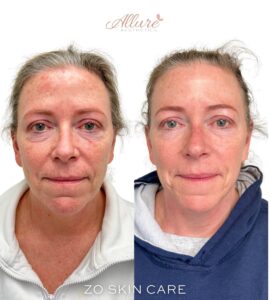
At Allure, our skincare specialists build customized regimens around lines like ZO Skin Health, which were developed specifically to repair and maintain barrier function while addressing concerns like pigment, texture, and aging in parallel. That’s also why we don’t sell products in isolation. The product matters less than the plan.
If a peel or laser is on your radar, the regimen we build with you isn’t just “skincare to use in the meantime.” It’s prep work. By the time you’re sitting in the treatment chair, your skin will tolerate more, recover faster, and respond better. That’s how compounding aesthetic results actually happen.
What to expect at Allure Aesthetics (King of Prussia, PA)
Our process for skin barrier and skincare planning is designed to slow things down enough to actually work, then move quickly once the foundation is set.
- A real assessment. We look at the barrier first: what it’s doing, what’s compromising it, and what it needs.
- A regimen built for your skin. Not the most products, the right products, in the right order, at the right cadence.
- A treatment runway. If a peel, Moxi, BBL, or microneedling is part of the long-term plan, we map home care into the timeline so the eventual treatment performs to its full potential.
FAQ: Skin barrier health
How long does it take to repair a damaged skin barrier?
Most people see meaningful improvement in 2 to 4 weeks of simplified, supportive care. More compromised barriers (chronic over-exfoliators, post-procedure damage, long-term harsh cleansers) can take 6 to 12 weeks to fully recover.
Can I still use retinoids if my barrier is compromised?
Usually not at full strength. Most clients do better pausing retinoids during active barrier repair, then reintroducing at a lower strength or frequency once the skin is calm. A provider can guide the timing.
Do I need a separate “barrier repair” product, or is a good moisturizer enough?
Typically, no. Barrier repair isn’t about adding a single product-it’s about improving how the skin functions as a whole.
Should I really wait before getting a chemical peel or laser?
If your barrier is compromised, yes. A short skincare runway dramatically improves results and recovery. If your barrier is already healthy, you can often move forward right away. We assess this directly at consultation.
Is “skin barrier” just a buzzword?
The term is having a moment, but the underlying biology is real and well-studied. The barrier is a defined anatomical structure with measurable function (TEWL, pH, lipid composition). It’s worth taking seriously, even if it’s also being marketed at you.
The takeaway
The most underrated upgrade in skincare isn’t a new active or a trending procedure, it’s a healthy skin barrier.
When the barrier is intact, products absorb properly, treatments work the way they’re supposed to, and your skin holds onto hydration and clarity without much help. When it isn’t, you can spend years (and a lot of money) chasing results that the foundation simply can’t support.
If you’re considering a chemical peel, a laser treatment, microneedling, or any of the more advanced services on our menu, the smartest first step is almost always the same: get the barrier right. Whether that takes four weeks or twelve, it’s the runway every great long-term result is built on.
If you’d like a regimen and treatment plan designed around your skin, not a one-size-fits-all menu, our team at Allure Aesthetics in King of Prussia, PA is happy to build one with you. Feel free to reach out to us via phone or email, or schedule your first appointment.